Before you call
How to tell your carpet actually needs cleaning
The traffic lane that has gone dull, the spill that is still wet versus one that has already dried, the household running on a shorter clock than most. Four signs worth checking on your own floor before you decide what it needs.
Chapter 01
The signal homeowners miss: traffic lanes go dull before they look dirty
By the time a carpet reads as dirty from across the room, it has usually been overdue for a while. The earlier sign shows up in a much smaller place: walk your hallway or the path from the front door to the kitchen and compare it to the carpet under a chair that never gets stepped on. If the lane is a shade duller than the protected carpet beside it, that difference is soil ground down into the pile, not surface dust that a vacuum lifts back out.
That greying is abrasive. Every footstep after it appears works the soil deeper and cuts at the fibre itself, which is why a traffic lane that gets cleaned early comes back closer to its original colour than one that waits a year past the point someone finally notices it.
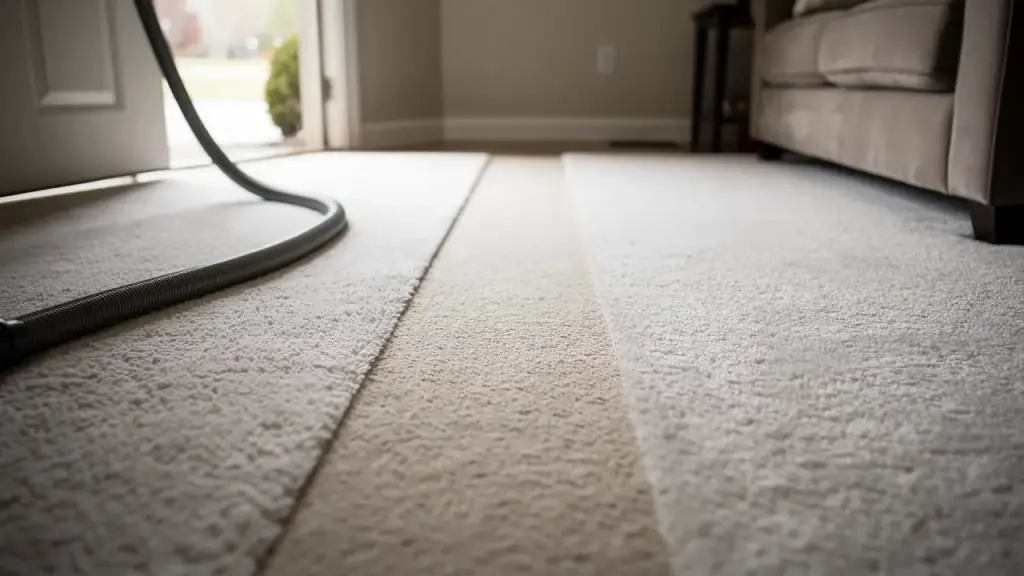
Carpeted room at floor level in soft light, the kind of everyday wear this page is about
Households with kids, pets or allergies run on a shorter clock
The 18 to 24 month interval we tell most callers for upholstery, and a roughly similar window for carpet in an average household, assumes an average household. Children spill more than adults do and spend more time on the floor. Pets track in soil from outside on every paw and shed into fibre in a way that does not vacuum out completely. Either one on its own moves the clock up by several months, and both together can mean a household is due twice as often as a house with neither.
Allergies change the reasoning rather than the schedule. Carpet and upholstery hold dust, pet dander and pollen down in the fibre where a vacuum only reaches the top layer, so a household managing allergies gets more benefit from a shorter interval than the amount of visible soil alone would suggest.
Chapter 03
Cleaning before a stain sets vs after
Most spills are still just a spill in the first hour or two: liquid sitting in the fibre rather than bonded to it, which is what routine extraction is built to lift back out. Fruit punch, red wine and sports drinks are the exception. Their dye bonds to the fibre itself rather than resting on top of it, and once that bond sets, cleaning stops being the right tool for the job.
A set-in red stain is dye work, closer to what we do on a bleach spot than to a normal clean, because the fix is putting matched colour back rather than lifting out soil that is not actually there anymore. The practical version of this is simple: call about a fresh spill the same day if you can, and if it has already dried, say so when you call, because that changes what we bring with us.
Whole-house sanitizing: what it does and does not claim
Alongside a carpet clean, we advertise a hospital-grade whole-house disinfectant service covering up to 2,000 square feet for $75.00, safe around pets and plants. It is marketed for cold and flu season, which is the business's own promotional framing for when people tend to book it, not a medical claim being made on this page.
What it is: an added disinfectant pass across the square footage you book it for, done at the same time as a carpet clean so there is no separate visit. What it is not: a substitute for cleaning that is actually needed, and the $75.00 figure is advertised pricing rather than a fixed rate, so confirm the current number when you call.
Alabama Carpet Specialist: IICRC Certified Firm, locally owned and family operated in the Montgomery area since 1991.
Not sure which of these applies to your floor
Tell us what you are looking at and roughly how long it has been there. We will tell you what it needs and price it before anything starts.